Materials explained
SUS304 is a widely used stainless steel grade for kitchenware and food-contact applications, but a material name is only one part of evaluating baby dinnerware. Construction, finishes, joined components, care instructions and the information supplied by the manufacturer also matter.
Know what touches the food
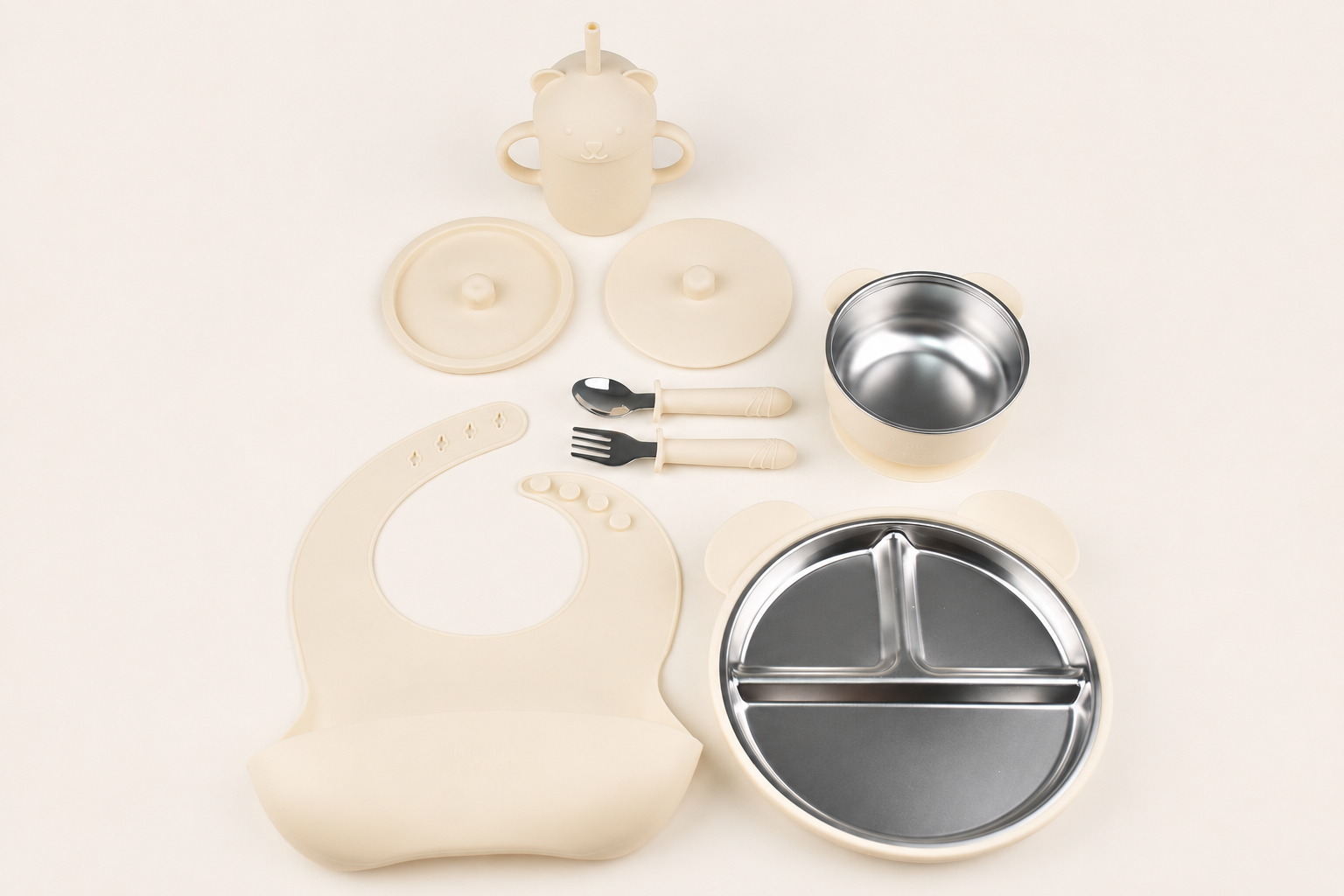
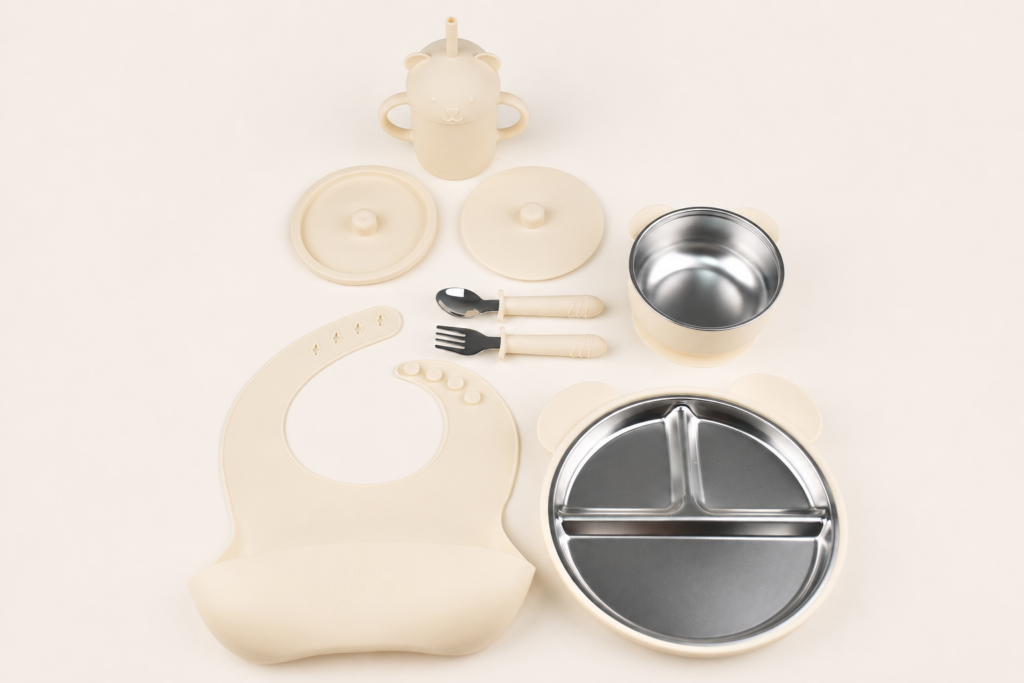
The Bear Set uses SUS304 stainless steel eating surfaces with removable platinum-cured silicone components.
What is 304 stainless steel?
Stainless steel is a family of iron-based alloys containing chromium, which supports corrosion resistance by forming a protective passive surface layer. Different grades use different compositions and are selected for different environments.
Grade 304 is commonly used in cookware, cutlery, food-processing equipment and household products because it combines corrosion resistance, durability and cleanability. The Australian and Japanese-style designation SUS304 refers to the same general grade family commonly described as 304 stainless steel.
For a broader technical explanation of stainless steel composition and corrosion resistance, see the information provided by worldstainless, the stainless steel association within the World Steel Association.
Does “18/8” mean the same thing as 304?
The term 18/8 is commonly used to describe stainless steel containing approximately 18% chromium and 8% nickel, proportions associated with many 304 products. However, 18/8 is a broad commercial description rather than a complete material specification.
If a listing states only “stainless steel” or “18/8”, ask for the actual grade when that information matters to your decision. Avoid assuming that every product with a similar appearance uses the same alloy or manufacturing process.
Why is 304 used for toddler dinnerware?
- Durability: it provides a firm eating surface suited to repeated everyday use.
- Corrosion resistance: appropriate use and care help maintain the surface.
- Cleanability: the smooth surface is easy to inspect and wash.
- Temperature tolerance: it handles ordinary hot and cold food service, within the product instructions.
- Long service life: a well-maintained item can be reused through many stages of feeding.
Stainless steel must never be placed in a microwave. If a plate combines stainless steel and silicone, keep the complete assembled item out of the microwave whenever the steel is attached.
Steel where food sits, silicone where flexibility helps
A hybrid design can use stainless steel for the eating surface and removable silicone for suction, grip, handles and softer contact points.
What 304 does not tell you
The grade does not describe the complete product. It does not automatically tell you:
- how edges and joins have been finished;
- whether coatings or decorations are present;
- which material is used in the base, lid or handles;
- whether small components are appropriate for the intended age;
- how the product should be cleaned;
- whether the finished item has been assessed against relevant requirements;
- whether the information in the listing is accurate.
That is why a useful product page should identify the food-contact materials, dimensions, age guidance, care limitations and supplier contact details instead of relying on “food grade” as a stand-alone slogan.
What should parents check before buying?
- Specific material information. Look for an identified stainless steel grade rather than a vague metal description.
- The complete construction. Check silicone, plastic, coatings, lids, straws and joined parts as well as the steel.
- Edges and condition. The product should be smooth, intact and easy to inspect.
- Age and supervision guidance. Use the product only for its intended stage and remain present during meals.
- Care instructions. Confirm dishwasher, microwave and temperature limitations.
- Traceable supplier information. You should be able to contact the seller if a component changes or is damaged.
- Current recalls. Australian consumers can check Product Safety Australia recalls.
How does silicone fit into a stainless steel set?
Silicone can provide a removable suction base, handles, lids, a straw or a bib while stainless steel provides the firm eating surface. The useful question is not simply which material is “better”, but whether each material is used appropriately and whether the components can be separated for cleaning.
The Bear Set uses removable silicone around its steel plate and bowl. Separating the parts gives access to the joins during washing and drying. Read the cleaning guide for the complete routine.
Can 304 stainless steel rust?
“Stainless” means corrosion-resistant, not impossible to mark under every condition. Harsh chemicals, damaged surfaces, prolonged contamination and unsuitable care can affect stainless steel. Follow the manufacturer’s instructions, rinse food and detergent residue, and dry joined components fully.
Is a magnet test a reliable way to identify 304?
No simple home magnet test can verify the full composition or quality of a finished product. Manufacturing and forming can change magnetic response in some areas. Use traceable product information rather than social-media shortcuts.
Frequently asked questions
Is SUS304 different from 304 stainless steel?
SUS304 is a designation commonly used for the grade family generally referred to as 304 stainless steel. Product specifications should still be checked in full.
Is all stainless steel toddler dinnerware the same?
No. Grade, thickness, finish, shape, joined components, manufacturing and care instructions can differ.
Does 304 mean BPA-free?
BPA is associated with certain plastics, not the stainless steel alloy itself. A complete product may contain other materials, so check each component rather than applying one claim to the whole set.
Can 304 stainless steel go in the microwave?
No. Metal dinnerware must not be microwaved.
Practical guidance by email
Make toddler mealtimes a little simpler
Receive occasional feeding-set guides, cleaning tips and product updates from PureSteel Co.
Clear materials, practical details
See exactly what The Bear Set includes
Review the SUS304 steel surfaces, removable silicone components, dimensions, age guidance and care instructions.